
Mobile Lead Barriers for Clinical Radiation Protection
Protect staff in imaging and procedure-room environments with mobile lead barriers designed to help shield teams from secondary and scatter radiation. Compare collapsible, opaque, wide-window, tilted, and reach-through options by window size, overall footprint, lead equivalency, mobility, and clinical use case. These leaded radiation barriers support radiology, cath lab, fluoroscopy, nuclear medicine, operating room, pain management, and other clinical workflows where portable shielding is needed.
Showing all 9 results
-

Collapsible Mobile Leaded Barrier with 27.5”W x 37.4”H Window
Portable collapsible leaded barrier with a 27.5”W × 37.4”H viewing window, hand-raised screen, and caster base for flexible procedure-room positioning. -
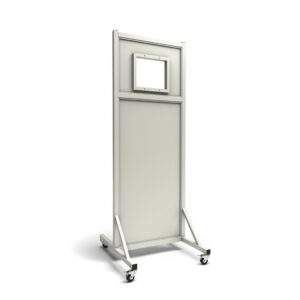
Mobile Leaded Barrier with 10”W x 12”H Window
Opaque mobile leaded barrier with a 10”W × 12”H lead-glass viewing window, heavy-duty casters, and multiple overall size options for clinical environments. -

Mobile Leaded Barrier with 24”W x 20”H Window
Mobile leaded barrier with 2.0mm PbEq contoured opaque panels, a 24”W × 20”H Schott leaded-glass window, and locking casters for secure positioning. -
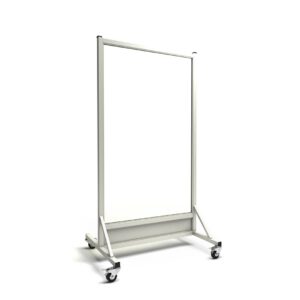
Mobile Leaded Barrier with 30”W x 60”H Window
Large-window mobile leaded barrier with a 30”W × 60”H viewing area, 2.0mm PbEq shielding, and caster mobility for procedures requiring expanded visibility and coverage. -

Mobile Leaded Barrier with 48”W x 30”H Window
Wide-window mobile leaded barrier with 48”W × 30”H viewing, 2.0mm PbEq shielding, and a caster base for positioning in procedure-room environments. -
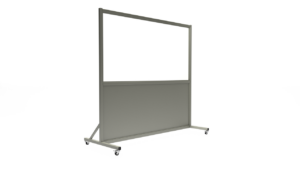
Mobile Leaded Barrier with 72”W x 36”H Window
Ultra-wide mobile leaded barrier with a 72”W × 36”H viewing window, 2.0mm PbEq shielding, and locking casters for broad viewing and flexible positioning. -
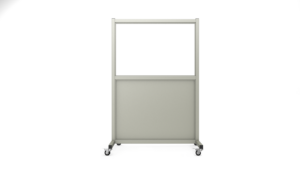
Nuclear Medicine Mobile Lead Barrier with 36”W × 24”H Window
Short, wide mobile leaded barrier designed for nuclear medicine workflows, featuring a 36”W × 24”H viewing window, 2.0mm PbEq shielding, and a space-conscious frame. -
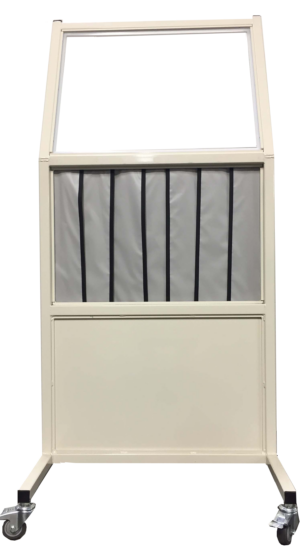
Reach-Through Tilted Leaded Barrier with 30”W × 24”H Window and Curtain
Reach-through tilted leaded barrier with a 30”W × 24”H window, lead ATM curtain, 2.0mm PbEq shielding, and locking casters for workflows requiring access through the barrier. -
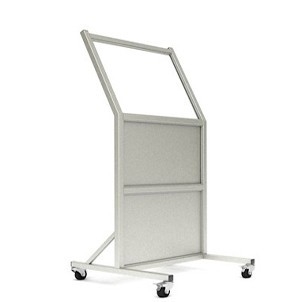
Tilted Mobile Leaded Barrier with 30”W x 24”H Window
Tilted mobile leaded barrier with a 30”W × 24”H viewing window, coated steel construction, 2.0mm PbEq shielding, and locking casters for procedure-room mobility.
Tested lead equivalencies performed to IEC 61331:1 2014 provided by Phillips Safety Products, Inc.
Frequently Asked Questions
What are lead barriers used for?
Lead barriers are portable shielding solutions used in procedure rooms, radiology, cath labs, fluoroscopy, and nuclear medicine environments to help protect staff from secondary or scatter radiation while allowing visibility through leaded-glass or leaded-acrylic windows.
How should I choose a mobile leaded barrier?
Compare the window size, overall barrier width and height, opaque panel coverage, caster configuration, weight, and whether the room requires a standard, collapsible, wide-window, tilted, or reach-through configuration.
What is the difference between standard and tilted mobile barriers?
Standard mobile barriers provide upright shielding with several window sizes and overall widths. Tilted barriers use an angled configuration and can be selected with or without a lead ATM curtain for reach-through workflows.
Are these barriers intended for primary beam exposure?
These barriers are intended to help shield staff from secondary or scatter radiation in clinical imaging and procedure-room environments. They should not be represented as protection from direct primary beam exposure unless specifically supported by the applicable product documentation. Follow facility radiation safety protocols and manufacturer guidance when selecting and using shielding.
Need Help Choosing a Barrier?
For room-fit, mobility, and workflow questions, contact your Burlington Medical account manager.
Explore Barriers & Drapes or browse solutions for Cath Lab, Radiology, Operating Room, and Nuclear Medicine.